
Where water, energy, data, and economic benefits flow together—BKT’s Co-Flow Campus turns wastewater treatment costs into profit and sets a new global standard.
What is the Co-Flow Campus?
For over a century, sanitation infrastructure has played a vital role in improving public health. But in the era of climate change, rapid urbanization, and digital transformation, traditional wastewater treatment plants (WWTPs) are no longer enough.
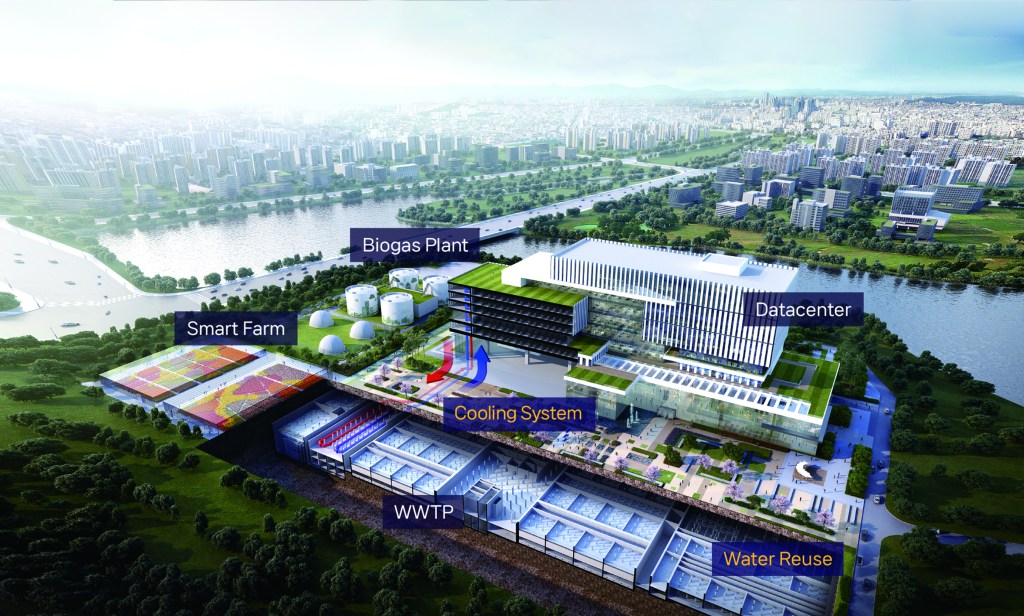
Co-Flow Campus is BKT’s answer to this challenge. It is a next-generation model that reimagines WWTPs not as cost centers, but as integrated, value-generating hubs. Here, water, energy, data, and economic opportunities are designed to flow together in a compact, circular, and smart infrastructure.
Why do we need a new wastewater treatment model?
Conventional WWTPs focus solely on pollutant removal, requiring significant land, energy, and cost. Many developing regions still lack basic infrastructure due to limited budgets and competing priorities.
The Co-Flow Campus model proposes a new standard—one that:
- Treats wastewater efficiently using minimal space
- Produces renewable energy from organic waste
- Reuses water for irrigation or data center cooling
- Recovers nutrients to support green cultivation
- Integrates smart technologies and digital services
Watch the Co-Flow Campus in Action
From Vision to Reality: Real-World Implementation
The Co-Flow Campus is more than just a vision.
It is a real, proven solution already being implemented through BKT’s technologies and strategies.
Designed around the co-flow of water, energy, data, and value, the Campus integrates compact, smart infrastructure ideal for urban environments.
It addresses the challenges of limited land and budget—making it suitable for both developed and developing regions alike.
The model also aligns with multiple UN Sustainable Development Goals (SDGs) and is gaining attention as a practical solution for climate resilience and urban innovation.
Want to learn more about the Co-Flow Campus?

Leave a comment