
Discover how BKT’s Co-Flow Campus turns wastewater infrastructure into a smart, circular urban solution—delivering clean water, energy, and resilience in compact spaces.
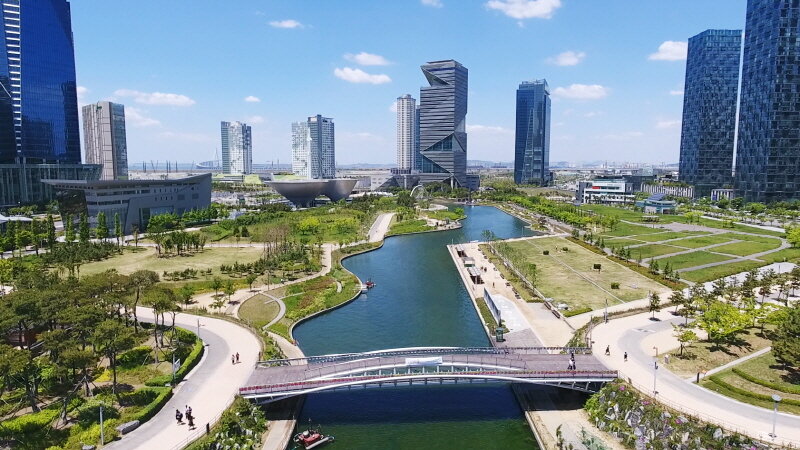
Urban challenges like water scarcity, energy insecurity, and waste overload are no longer future threats—they are urgent realities.
Rapid urbanization and climate uncertainty are pushing cities to modernize outdated infrastructure under growing pressure.
The Co-Flow Campus (CFC) was designed to meet these challenges head-on, offering a scalable, practical model that reimagines the role of wastewater infrastructure in the urban landscape.
Integrating Wastewater Infrastructure into the Urban Core
For decades, wastewater treatment plants (WWTPs) have been essential yet isolated—pushed to city edges, occupying vast land, and offering little visible benefit to communities.
The Co-Flow Campus transforms that narrative.
By combining water treatment, energy generation, resource recovery, and smart infrastructure, CFCs reposition WWTPs as high-value, multi-functional urban assets.
Located closer to city centers, they use land efficiently and provide tangible benefits: clean water, renewable energy, cooling for data centers, and nutrient-rich fertilizer.
Infrastructure is no longer hidden—it becomes visible, valuable, and integrated with the city’s life.
Enabling Circularity and Carbon Reduction
Governments and industries worldwide are striving toward net-zero targets and circular economies. Co-Flow Campus actively supports these ambitions through:
- Carbon reduction: On-site biogas replaces fossil fuels, cutting greenhouse gas emissions
- Waste minimization: Solids, nutrients, and thermal energy are recovered—not discarded.
- Material circularity: Nutrients like nitrogen and phosphorus become agricultural inputs.
- Water reuse: Treated water is repurposed for cooling, irrigation, and urban applications, easing pressure on freshwater sources.
By delivering these benefits within a compact footprint, CFC helps cities achieve more—with less land, less energy, and less waste.
Strengthening Local Energy Resilience
Cities need decentralized, renewable energy systems to withstand climate shocks, geopolitical uncertainty, and rising demand.
Co-Flow Campus strengthens local resilience by generating energy where it’s needed—on-site and in real time.
Biogas from organic waste powers not only the CFC itself, but also nearby infrastructure such as smart farms and data centers.
This model supports grid independence, boosts self-sufficiency, and offers a stable, low-carbon power supply aligned with urban decarbonization strategies.
Scalable Innovation for Global Impact
While designed for high-density urban areas, Co-Flow Campuses are also ideal for emerging cities and developing economies.
Their modular structure and integration of essential services make them attractive where land, capital, and technical capacity are limited—but the need for sanitation, energy, and economic development is high.
Co-Flow is not just Korea’s solution—it’s a globally relevant innovation with local adaptability.
Built for Today, Ready for Tomorrow
What makes Co-Flow Campus truly matter is its readiness. This is not a prototype or distant dream.
BKT has already commercialized the technologies behind CFC, and real-world projects are underway with global partners.
The Co-Flow Campus shifts infrastructure from linear, single-purpose facilities to integrated systems that deliver multiple urban benefits—resilience, circularity, sustainability, and economic regeneration.
In a world of accelerating urban pressures, the Co-Flow Campus is not just an option—it’s a necessity.
It’s the infrastructure model our cities need today—and the foundation for the future we build tomorrow.
Ready to learn more?

Leave a comment