BKT CEO Dongwoo Kim shares the company’s vision to transform wastewater plants into revenue-generating hubs through biogas, data centers, and global expansion.
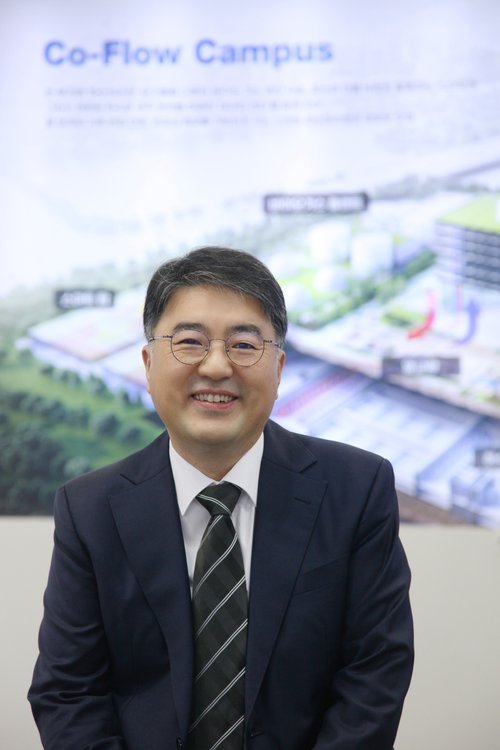
[Zoom-Up CEO] Dongwoo Kim, CEO of BKT
“Solving humanity’s sanitation crisis is why we exist.”
- Specialized wastewater treatment services in the U.S.
- Courted by major corporations including Pulmuone
“A wastewater treatment plant should no longer be a place that spends money, but one that makes money.” said Dongwoo Kim, CEO of BKT, during an interview with the Seoul Economic Daily at the company’s Daejeon headquarters on June 1. When asked about the vision for future-oriented wastewater treatment, Kim pointed to the company’s innovative model.
BKT’s answer to the future of wastewater treatment is the Co-Flow Campus—a concept that integrates facilities for biogas production from organic waste such as sewage sludge, and data centers that use treated water as cooling water, all co-located on the same site as the wastewater treatment plant. The goal: protect the environment and generate revenue. This model gives shape to BKT’s “Tomorrow Water Project (TWP),” an initiative first introduced in 2016 and officially listed on the UN’s Sustainable Development Goals (SDGs) platform. TWP is driven by the mission to transform wastewater treatment from a cost stream into a profit stream.
For these efforts, Kim has been named a Global Sustainable Innovation Leader for five consecutive years by the UN SDGs Association. He is the only leader from the wastewater treatment sector to receive this recognition five years in a row.
Kim emphasized, “BKT exists to solve sanitation challenges in developing countries where sewer infrastructure is lacking,” adding, “To do that, we must create systems where the more wastewater we treat, the more economic benefits we generate.” He predicted, “In the future, wastewater treatment plants will evolve from simple treatment facilities into carbon-neutral complexes that also function as biogas plants, data centers, smart farms, and public parks.”
BKT is one of the few Korean wastewater companies that has successfully expanded overseas. Its services supporting wastewater treatment for manufacturing facilities in the U.S. have received high praise. The company completed a turnkey wastewater treatment project for Pulmuone’s tofu factory in California, and recently secured projects for major industrial facilities in Georgia, including a semiconductor factory by Absolics, an SKC subsidiary, and a large-scale solar module production plant. One of these projects was particularly notable, as BKT won the contract through a selective bidding process involving only three companies, organized by Gray Construction, the project’s general contractor. Kim noted, “It’s a symbolic example that shows how a Korean SME can stand toe-to-toe with global water treatment giants in terms of technology and price competitiveness.”
He continued, “Environmental regulations in the U.S. differ significantly from those in Korea. On top of federal laws, each state has its own set of rules, creating major challenges for Korean companies entering the market.” BKT navigates this complexity through its U.S. subsidiary, which communicates directly with local regulatory agencies to design compliant processes. Technologies validated in Korea are then applied locally, minimizing trial and error. “While U.S. engineering and equipment are extremely expensive, we provide cost-effective services. With over 15 years of on-the-ground experience in the U.S., we understand the challenges Korean companies face better than anyone,” he added.
BKT now plans to accelerate its scale-up strategy. After returning to profitability in 2023 for the first time in five years, the company expects this momentum to continue. Annual revenue grew from KRW 20.9 billion in 2022 to KRW 25.5 billion in 2023—a 22% increase.
Kim concluded, “The U.S. water treatment market feels dozens of times larger than Korea’s. Since last year, our U.S. revenue has already surpassed domestic sales. We’re also planning to enter markets like Saudi Arabia, so our overseas revenue is expected to grow even further.”
*Source: April 1, 2024| Seoul Economic Daily
Interested in BKT and TW?

Leave a comment