As water demand and climate resilience needs grow, Proteus sets a new standard in primary treatment with up to 85% footprint reduction and proven performance at scale.

More clean water, less land
Why Proteus? Why Now?
Traditional primary treatment systems—such as gravity settlers—require large land areas and often deliver inconsistent performance, especially under variable influent conditions.
As cities confront land shortages, climate-driven wet weather events, and growing demands for energy efficiency, the need for a better solution has become urgent.
This is where Proteus comes in.
With its high-speed upflow filtration system and buoyant media, Proteus captures up to 80% of suspended solids and organics in just 15 minutes—using only 20% of the space required by conventional systems.
✅Up to 85% footprint reduction
✅ No chemicals required
✅ Recovers more organics for biogas
✅ 15-minute retention time
✅ Easy retrofitting of existing tanks
Whether used for primary treatment or as a hybrid solution for stormwater and combined sewer overflows, Proteus is the go-to solution for compact, energy-resilient, and future-ready treatment systems.
Field-Proven at Scale
Proteus isn’t just a concept—it’s proven in large-scale, real-world applications.
Jungnang Water Resource Recovery Facility (Seoul, Korea)
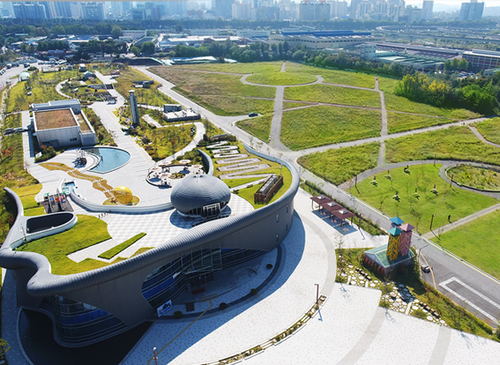
Replacing conventional clarifiers in a 250,000 m³/day facility, Proteus reduced the primary treatment footprint by 85% and the overall plant footprint by over 60%, enabling full underground construction.
Seonam Water Resource Recovery Facility (Seoul, Korea)
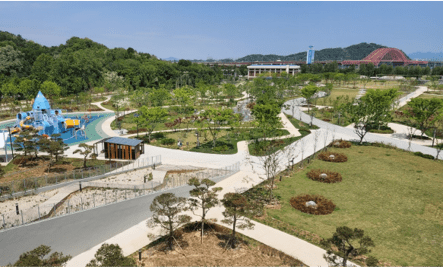
Treating up to 720,000 m³/day of wet weather flow, this is the world’s first large-scale dual-mode system operating under both dry and storm conditions.
In the United States, the first pilot demonstration was carried out in Genesee County (Michigan), followed by a second pilot at the Milwaukee wastewater treatment plant, launched after winning The Water Council’s pilot competition. Both projects were completed successfully, further validating Proteus’ performance and adaptability.
Video Spotlight
“We need these new options to meet the challenges of the future.”
-Dr. Glen Daigger, Ph.D., P.E., BCEE, NAE
Expanding in the U.S.
After Proteus successfully completed pilot testing, the Milwaukee Metropolitan Sewerage District (MMSD) began pursuing a $13 million Proteus demonstration plant. Designed by Black & Veatch, the facility is targeted to break ground in 2026.
Climate change has increased early stormwater inflows, leading to untreated overflows into rivers and lakes—a major concern for U.S. regulators due to risks of viral and bacterial contamination. Building on the proven pilot results, MMSD sees Proteus as a breakthrough solution, upgrading existing primary clarifiers to enable compact facilities to manage storm surges more effectively.
BKT aims to establish Proteus as the new standard in primary wastewater treatment, addressing growing demands for sanitation, climate resilience, and water quality protection.
Want to learn more about Proteus?

Leave a comment