BKT’s CEO shares the company’s plan to build 10 Co-Flow Campuses by 2040, transforming urban wastewater into renewable energy across Korea and the developing world.
- Groundbreaking Land-Saving Technology
- Smart Water City Project in the Works
- Modernizes Jungnang Water Reclamation Center
- Series of Contract Wins in the U.S. Market
What has most significantly improved human life? According to a 2007 study by the British Medical Journal, the answer is “sanitation.” And central to sanitation is access to clean water.
In Korea, one environmental company has been gaining attention for its unwavering dedication to transforming dirty water into clean water. Founded in 1998, BKT develops advanced wastewater treatment systems and is on a mission to revolutionize not just Korea’s wastewater ecosystem, but the global one.
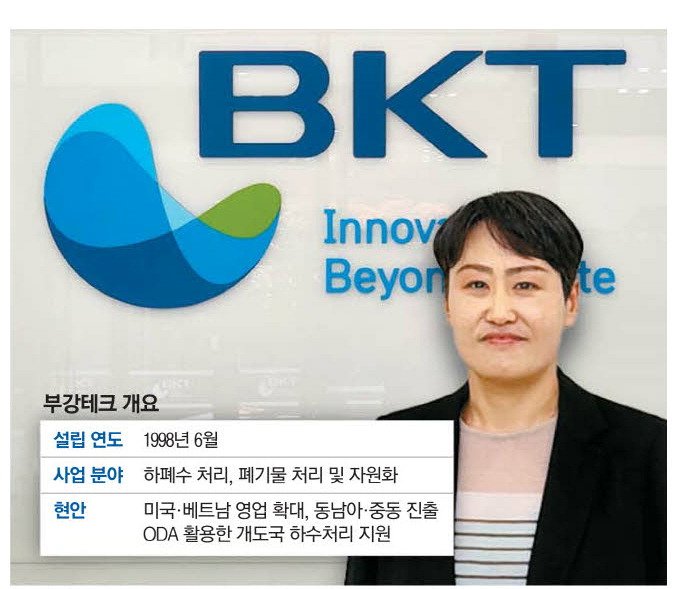
We recently sat down at BKT’s headquarters in Daejeon with its newly appointed CEO, Moonjin Choi, who took office this April.
Choi, who majored in civil engineering, joined BKT in 1998—when it was still a fledgling startup. At the time, BKT’s only technology was a nitrogen removal solution for livestock wastewater. Through years of R&D, the company has developed numerous wastewater treatment technologies and has since become one of the most prominent environmental firms in Korea.
Today, BKT offers customized, site-specific solutions at more than 60 locations across Korea, leveraging its core livestock wastewater purification technologies.
At the heart of BKT’s technological innovation is Proteus, a groundbreaking solution that drastically minimizes land requirements for facility construction. By applying Proteus, wastewater treatment plants can free up significant land area. For example, Seoul’s Jungnang and Seonam Water Reclamation Centers adopted this technology and successfully reduced their facility footprints by over 60%.
Building on Proteus, BKT’s Integrated Upstream Process (IUP) goes further—producing biogas, removing nitrogen from wastewater, and reducing sludge generated during the treatment process. It’s a fully integrated and highly efficient solution.
CEO Choi envisions creating an entirely new wastewater treatment ecosystem through what BKT calls the Co-Flow Campus. He believes this model will significantly increase urban value.
“A Co-Flow Campus isn’t just a treatment plant,” Choi explains. “It includes biogas production facilities and smart farms. Organic matter is extracted from wastewater to produce biogas, while nitrogen and phosphorus are turned into fertilizer for smart farming. The purified water can even be reused as cooling water for data centers.”
But the impact of the Co-Flow Campus goes beyond Korea. “Korea has been ramping up its ODA (Official Development Assistance) budget,” Choi notes. “We aim to implement BKT’s unique sustainable system in developing countries to help them achieve energy self-sufficiency.”
According to BKT, once a Co-Flow Campus is established in a developing country, it creates a self-sustaining cycle of water, energy, and data—without requiring ongoing financial input.
Choi concludes, “By 2040, we plan to build 10 Co-Flow Campuses in Korea and expand to the U.S., Southeast Asia, the Middle East, and India—elevating urban value and positioning BKT as a global leader in wastewater treatment.”
*Source: June 17, 2025| Maeil Business Newspaper
Explore the future of wastewater treatment

Leave a comment