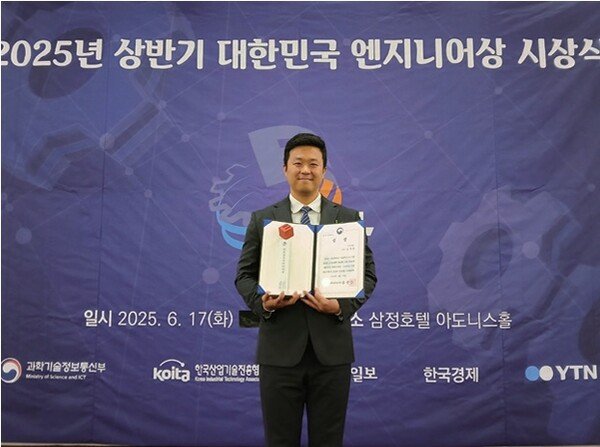
Taeseok Oh of BKT wins the 2025 Korea Engineer Award for leading Korea’s first commercialization of AMX, a next-gen nitrogen removal solution for wastewater.

- Developed and commercialized Korea’s first Two-Stage AMX technology with both economic and operational advantages
- Busan’s Noksan WWTP saves KRW 1.5 billion annually and achieves tenfold improvement in energy self-sufficiency
- U.S. pilot completed in 2025; full-scale implementation confirmed—Korean AMX goes global
“AMX Development and Commercialization Earns Official Recognition”
Q: Congratulations on receiving the Korea Engineer Award. As the key figure behind Korea’s first AMX commercialization, what does this award mean to you?
When I first joined the AMX project, I was the youngest member on the team. From cultivating microorganisms in small batches to developing processes and achieving full-scale implementation, I was able to witness each stage firsthand—an invaluable experience.
At the time, many doubted that Korea could develop such a technology or apply it in real-world settings. But I believed that if it was possible overseas, it could be achieved here too. I made it my mission to create a Korean version of AMX and share it with the world.
This award feels like a recognition not just for me, but for all my colleagues who shared this journey. It’s especially meaningful because it affirms that young engineers can pioneer and apply new technologies from scratch—and be officially recognized for doing so.
“AMX: A Cost-Effective and Eco-Friendly Nitrogen Removal Technology”
Q: What is AMX, and why is it drawing attention now?
AMX is a core technology for treating high-strength nitrogen wastewater from anaerobic digesters. Compared to conventional nitrification-denitrification processes, AMX can reduce energy use (aeration) by 65% and eliminate the need for external carbon sources, cutting operating costs by up to 80%. It also reduces required land area by more than 50%, lowering civil construction costs.
With the new “Act on the Promotion of Biogas Production from Organic Waste,” AMX has become even more critical. Efficient nitrogen removal is now essential for successful biogas projects. While conventional methods could negate profits with high O&M costs, AMX offers a reliable, economical solution.
As a result, interest in AMX is surging, with municipalities and private companies nationwide actively seeking to adopt the technology.
“BKT’s AMX: Improved Operation and Space Efficiency”
Q: How is BKT’s AMX different from conventional methods, and what gives it a competitive edge?
Unlike conventional systems that house all microbes in one reactor, BKT developed a Two-Stage AMX system that separates partial nitritation and anammox bacteria into two reactors. This allows for faster recovery during upsets and reduces land use by half, securing both stability and cost-effectiveness.
We also overcame the challenge of cultivating anammox bacteria—known for their slow growth—by establishing Korea’s only large-scale cultivation facility at the Daejeon WWTP. This enables rapid recovery in emergency situations, something global competitors cannot match.
“AMX Pilot Results Published in Top Water Engineering Journal”
Q: What challenges did you face during the pilot project at Noksan WWTP?
The biggest challenge was the high sulfate concentration in incoming wastewater from the Noksan Industrial Complex—500–600 mg/L, far above the threshold for anammox inhibition. Microbial activity dropped to 44%.
We addressed this by adjusting upstream holding tank conditions and adding iron salts to reduce sulfate levels. As a result, we achieved a 84.6% total nitrogen removal rate—well above the target of 75% (or even the guaranteed performance target of 82%).
This success was officially recognized by the Journal of Water Process Engineering (JWPE), one of the top 5% journals in the water sector.
“KRW 1.5 Billion Saved Annually at Noksan WWTP Thanks to AMX”
Q: What operational outcomes has Busan City seen since implementing AMX?
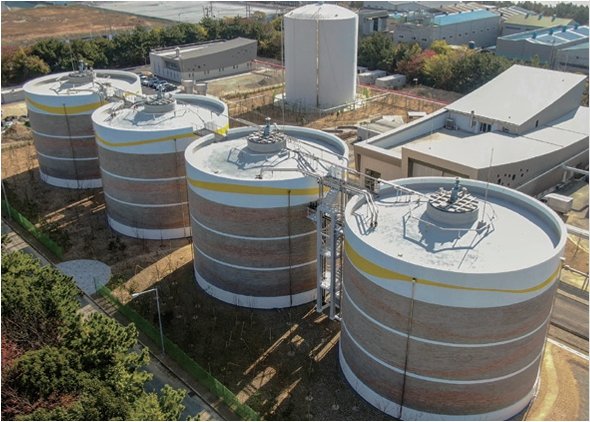
Since its completion in May 2023, the AMX facility at Noksan WWTP has been running smoothly. Compared to the previous process, Busan City has reduced power consumption by 60%, chemical costs by 99%, and sludge treatment costs by 49%, saving over KRW 1.5 billion annually.
Energy self-sufficiency has increased tenfold—from 3.8% in 2022 to 34.9% in 2023—well above the national average of 14.8%. This was achieved by maximizing biogas production and applying AMX to minimize energy consumption.
As word spreads, local governments across Korea are requesting site visits to learn from the Noksan model.
“Site-Specific AMX Deployment and Trusted Technology Sharing”
Q: AMX adoption is spreading fast. What enables its flexible application and what’s your expansion strategy?
As of 2026, private companies will also be required to produce biogas from organic waste. AMX demand will increase as a result.
We’re seeing continued interest from engineering firms, construction companies, and municipalities. The Daejeon WWTP relocation project is already using AMX, and private-sector projects are also in progress. Cost savings in O&M are a key driver.
Rather than relying solely on promotion, we focus on building trust—backing our claims with data, technical seminars, and pilot results. This has proven more persuasive than marketing alone.
We’ll continue to tailor AMX solutions for specific site conditions while reinforcing customer trust through performance-based evidence.
“GWI Names BKT’s AMX Among Top 10 Anammox Technologies”
Q: Has AMX been recognized in global markets?
Yes. BKT’s AMX was tested at LA’s Hyperion WWTP—one of the largest U.S. wastewater facilities—starting in 2017. The results showed high nitrogen removal even with elevated solids and organics, without dilution.
This success was shared at WEFTEC 2020, and in 2021, GWI (Global Water Intelligence) ranked our AMX among the world’s Top 10 Anammox technologies. It was also selected for the “Top 50 Papers to Watch” at WEFTEC in both 2021 and 2024.
Most recently, in partnership with Quantum Organics in Connecticut, we conducted a pilot test and secured full-scale implementation by the first half of 2025. It’s rare to move from pilot to construction this quickly—proof of the technology’s reliability.
It’s fulfilling to see my vision from a decade ago—globalizing Korean AMX—come to life in the U.S.
“Advancing AMX for a Sustainable, Global Future”
Q: What’s next for AMX and your long-term goals?
BKT’s AMX has received numerous accolades: Korea Patent Office Grand Prize (2020), Korea’s first full-scale implementation (2023), selection by the National Academy of Engineering of Korea (2023), and GWI’s Top 10 listing.
Yet we are not stopping. Our ultimate goal is to bring Korean AMX to global markets—including Europe, where Anammox technology originated.
AMX is also a core part of our Tomorrow Water Project (TWP)—a future-oriented solution that integrates WWTPs, biogas plants, and data centers. AMX plays a crucial role in achieving energy independence, carbon neutrality, and resource recovery within this model.
We believe technology must prove itself in the field and ultimately improve people’s lives. That’s the goal we’ll continue striving toward through ongoing AMX innovation.
*Source: Water Journal, July 2025 Issue
Interested in implementing AMX at your facility?

Leave a comment