Discover how the Tomorrow Water Project and Co-Flow Campus are redefining wastewater treatment plants by turning sewage into a resource for energy, agriculture, and data, all while enhancing urban sustainability.
Have you already forgotten about COVID?
Microorganisms and viruses excreted through feces are major contributors to the spread of infectious diseases in cities.
The British Medical Journal announced that sanitation has contributed more to increasing human life expectancy over the past 160 years than vaccines or antibiotics.
If the coronavirus had been a waterborne disease, the populations of developing countries might have drastically declined.
There is growing concern that viruses frozen in permafrost for tens of thousands of years could awaken and spread due to climate change.
However, in many countries, sewage treatment coverage remains below 20%.
Although life is precious, urgent concerns about food and livelihood often overshadow preparations for an uncertain future.
“From Cost Stream to Profit Stream”
The UN emphasizes the importance of water and sanitation in its Sustainable Development Goals (SDGs).
Infectious diseases that cross borders demand a coordinated global response.
Yet, why is sewage treatment still delayed in many regions?
This issue is closely tied to sustainability.
Even with international support, the enormous annual operation and maintenance costs are difficult to bear.
Can a country that struggles to power its own lights operate an energy-intensive sewage treatment plant?
To solve this, we launched a new vision for future sewage treatment—Tomorrow Water Project (TWP).
TWP turns conventional cost-draining treatment plants into profit-generating infrastructure by maximizing economic value from every drop of wastewater.
It aims to enhance sustainability by transforming sewage treatment into a business opportunity.
Tomorrow Water Project (TWP) and Co-Flow Campus (CFC)
We focused on the overlooked potential of substances in sewage—once merely seen as pollutants.
Sewage contains organic matter (a biogas source), nitrogen and phosphorus (key nutrients for plants), and reusable water.
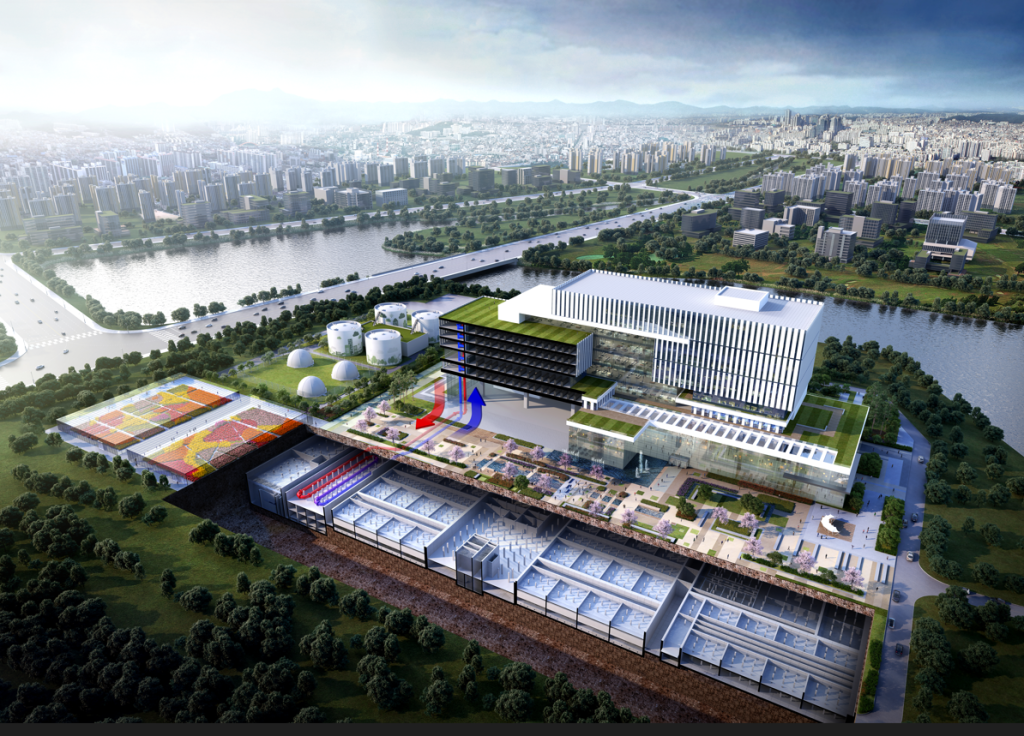
By building data centers within sewage treatment facilities and generating revenue from land leasing and cooling water sales, treatment costs can be offset.
Treated water can be used for artificial lakes or maintaining rivers, thereby enhancing urban value.
Thus, future sewage treatment plants will evolve into multi-functional spaces that address public hygiene, climate change, and urban value enhancement—while also generating profits and achieving carbon neutrality.
Dirty water that once passed through old sewage treatment plants will be reborn as new urban infrastructure, combining biogas plants, smart farms, data centers, and SMRs.
We call this integrated model Co-Flow Campus, as water, energy, data, and economic value all flow together.
In the post-COVID era, Co-Flow Campus also strengthens partnerships with specialized companies for sewage-based infectious disease monitoring.
To formalize this effort, we registered the Tomorrow Water Project (TWP) as an official SDG Action (#40493) in 2016, the inaugural year of the UN SDGs.
Since then, we have continuously updated and evolved the initiative.
Core technologies for implementing the Co-Flow Campus have already been commercialized and proven, including:
- Proteus: For retrofitting aging plants and site development
- AAD: Biogas production through advanced anaerobic digestion
- AMX: Cost-effective nitrogen removal from wastewater
- Draco: Biogas amplification and sludge reduction
- Co-Flow: Data center cooling using treated sewage water
Not by Size, but by Impact!
The future of global leaders will be defined not by sales figures or workforce size, but by the impact they create.
True impact arises when companies present a visionary future, offer global leadership, and bring innovative technologies that previously didn’t exist.
For the past 30 years, BKT and Tomorrow Water have presented new visions for sewage treatment and devoted themselves to developing the technologies to realize them.
By combining innovation with leadership that addresses the sanitation challenges of developing countries, we strive to become impactful contributors—true impact makers—to the world.
Discover how TWP and CFC are shaping the future of wastewater treatment plants

Leave a comment