BKT and KAD are developing urban infectious disease response wastewater treatment plants through the Tomorrow Water Project, integrating energy, data, and health monitoring for sustainable cities.
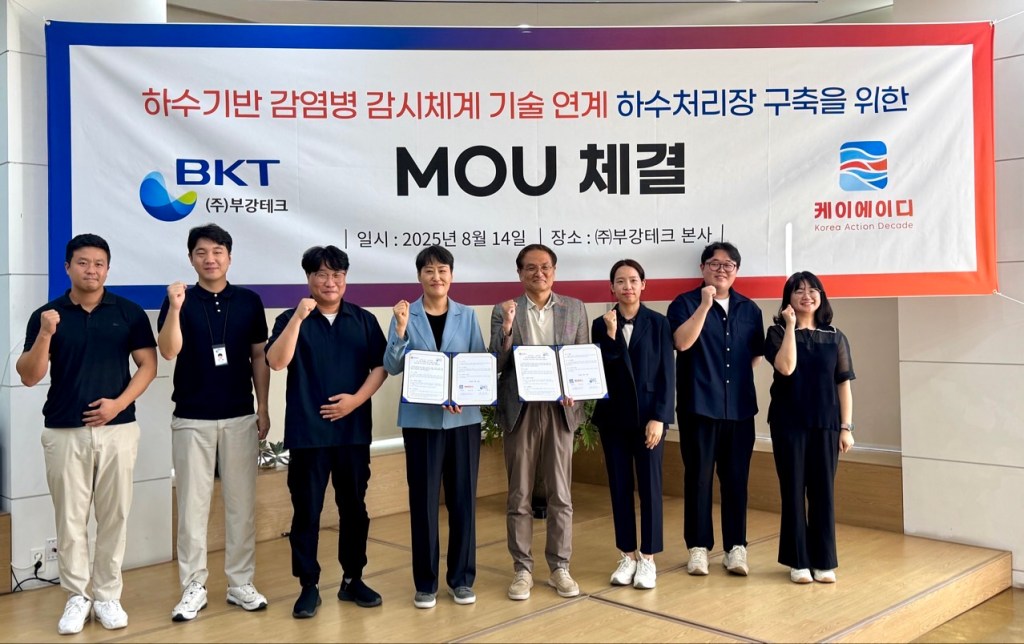
BKT and KAD have signed an agreement to jointly pursue the Tomorrow Water Project.
By combining their respective technologies, the two companies aim to present an entirely new model of the future wastewater treatment plant and expand into global markets, including developing countries.
Their primary mission is to provide sustainable solutions for public health and sanitation while strengthening Korea’s leadership and competitiveness on the international stage.
Microorganisms and viruses discharged through human waste are major drivers of infectious disease outbreaks in cities.
According to a survey published in the British Medical Journal, experts agreed that sanitation—not vaccines or antibiotics—has made the greatest contribution to human health over the past century.
Scholars also warn of the risk that ancient viruses, frozen in permafrost for tens of thousands of years, may awaken and spread due to climate change.
Despite the pain COVID-19 inflicted only a few years ago, humanity is already forgetting its lessons.
Wastewater treatment plants are essential to protect lives and water resources.
Yet, in many developing countries, coverage remains below 30%.
Even if construction costs are supported by international aid, enormous annual operation and maintenance costs remain a serious burden.
Can wastewater treatment plants evolve from cost centers into revenue-generating hubs that ensure sustainability?
BKT has been preparing this new vision for over 20 years.
In 2016, the inaugural year of the UN Sustainable Development Goals (SDGs), the company introduced the Tomorrow Water Project on its official website.
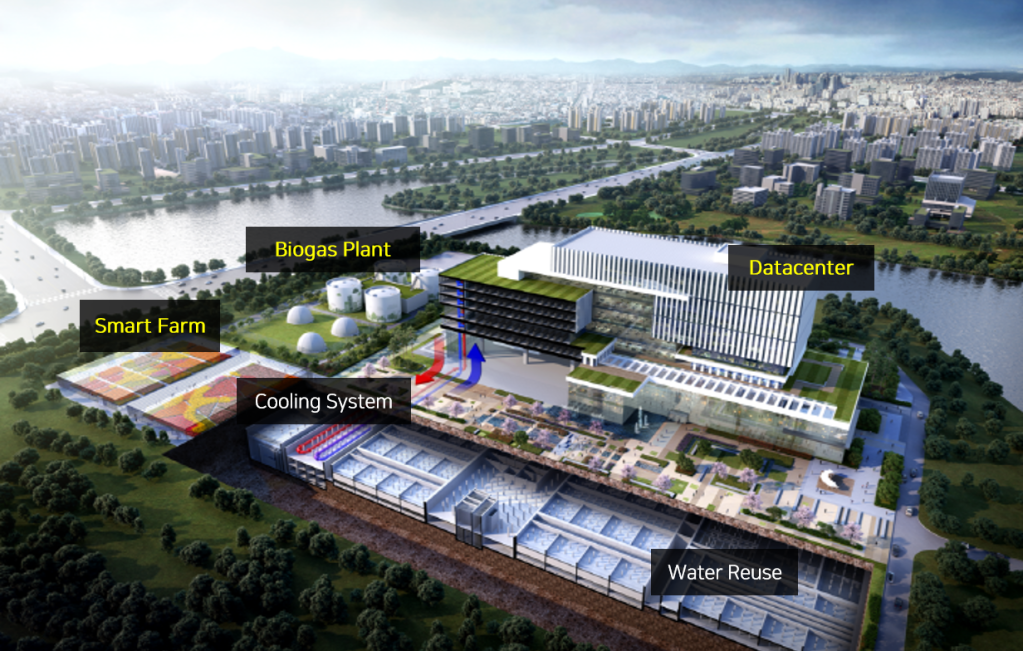
The concept proposed integrating wastewater treatment plants with biogas facilities, smart farms, data centers, and small modular reactors (SMRs).
Through this “Co-Flow Campus” model, wastewater plants—once places where only dirty water flowed—become sites where water, energy, data, and economic value flow together.
Organic matter in wastewater generates energy, nitrogen and phosphorus support plant cultivation, and reclaimed water cools data centers or SMRs.
Revenue streams such as rent or service fees then cover operating costs, eliminating financial concerns while enabling a sustainable future.
This vision, combined with technologies consistently developed, commercialized, and publicized by BKT, has positioned the company as a leader with both global influence and long-term foresight.
Still, the core mission of wastewater treatment plants remains protecting public health. That is why BKT has partnered with KAD.
KAD is Korea’s only company specializing in wastewater-based infectious disease monitoring, founded by Professor Sung-Pyo Kim of Korea University, a globally recognized expert in urban infectious disease management.
KAD’s system collects wastewater samples from treatment plants and pipelines, applying PCR-based genetic analysis to quantify pathogens and their concentrations.
This technology enables real-time monitoring of urban infection levels, including asymptomatic cases, while avoiding personal privacy concerns.
Furthermore, KAD has developed and commercialized UV-LED fluid disinfection technology, integrating monitoring and control into a single system.
Since joining the OECD, Korea has provided significant financial support to developing countries—not only as aid but also as a strategic investment in future competitiveness.
Today, Korea faces intense competition with China and Japan to expand infrastructure influence in Southeast Asia and beyond.
In this context, a wastewater treatment model that enhances economic value by integrating energy and data infrastructure—while simultaneously strengthening public health through infectious disease monitoring—is a breakthrough innovation.
BKT CEO Moon-Jin Choi stated:
“Presenting and proving a new model that goes beyond conventional ideas is how Korea can secure leadership and future competitiveness.
A model where data center operators pay land lease fees and water cooling charges, thereby funding wastewater plant operations, simply doesn’t exist anywhere in the world.
Its success depends on collaboration across industries and proactive government support.”
KAD CEO Sung-Pyo Kim added:
“Both companies have long shared the belief that wastewater facilities should not only treat water but also serve as forward bases that provide new value to citizens.
Wastewater reflects the lifestyle and health of cities.
By combining KAD’s infectious disease monitoring and data-mining technologies with BKT’s Co-Flow Campus model—where water, energy, and economic value converge—we can create sustainable smart cities both in Korea and abroad.”
Learn more about Tomorrow Water Project.

Leave a comment