BKT/Tomorrow Water’s Co-Flow Campus (CFC) offers a groundbreaking solution to data centers’ toughest challenges — water, power, and site constraints. Combining wastewater treatment with biogas, smart farms, and data centers, CFC enables sustainable growth through a PPP-based model supported by EDCF.
The Rising Challenge of Data Centers in a Resource-Constrained World
As the digital era accelerates, data centers have become the backbone of the global economy.
Yet their rapid expansion has brought three pressing challenges: land scarcity, soaring power demand, and water shortages for cooling.
Across the world — from North America to Asia and Africa — governments and utilities are struggling to balance the growth of AI and cloud infrastructure with limited urban land, strained electricity grids, and declining water resources.
In short, the world’s digital infrastructure urgently needs a new, sustainable model.
CFC: A Green Infrastructure Paradigm by BKT/Tomorrow Water
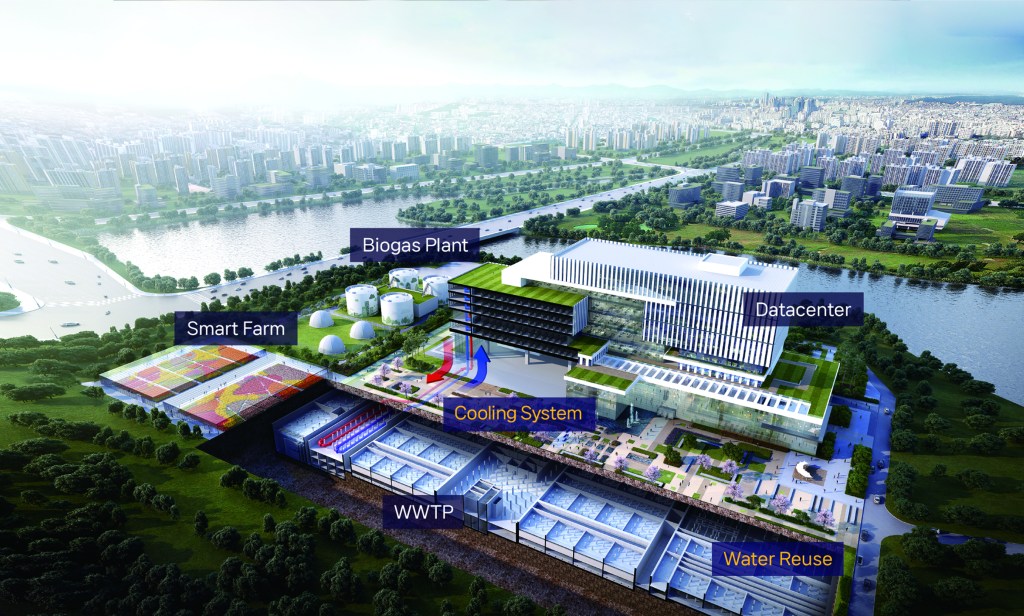
To address these intertwined challenges, BKT/Tomorrow Water developed the Co-Flow Campus (CFC) — a visionary yet practical model that integrates wastewater treatment, biogas production, smart farming, and data centers into a single, circular ecosystem.
CFC reimagines wastewater treatment plants as urban sustainability hubs where water, energy, data, and economic value flow together.
How It Works:
- Land: Wastewater treatment plants are typically located near cities — ideal sites already equipped with key infrastructure.
- Water: Treated effluent provides a stable and renewable cooling source, reducing pressure on freshwater supplies.
- Power: Biogas and solar power generated on-site supply part of the energy required for data center operation, cutting carbon emissions.
Through this integration, CFC transforms environmental burdens into synergies — creating self-sustaining, climate-resilient infrastructure perfectly aligned with the world’s carbon neutrality and circular economy goals.
Turning Wastewater into Economic and Social Value
At the heart of BKT/Tomorrow Water’s philosophy lies a bold idea:
“The more wastewater we treat, the more value we can create for people and the planet.”
BKT/Tomorrow Water exists to make wastewater treatment economically viable — turning what was once a public cost into a profitable and sustainable urban asset.
To realize this vision, the company launched the Tomorrow Water Project (TWP) in 2016 and registered it as an official UN SDGs initiative.
Through continuous global engagement, TWP drives BKT/Tomorrow Water’s mission to build a world where everyone has access to clean water and sustainable infrastructure.
A PPP-Based Model: Merging Public Good and Private Opportunity
CFC is not only a technological innovation but also a new financial model for developing countries.
By combining public funding through Korea’s Economic Development Cooperation Fund (EDCF) with private investment in data centers, BKT/Tomorrow Water has created a viable Public-Private Partnership (PPP) structure.
The Model in Action:
- The wastewater treatment plant is financed as an ODA project under EDCF, providing essential sanitation and energy recovery.
- The data center, built with private capital, generates revenue through land use and cooling water fees.
- Together, they form a self-sustaining ecosystem that funds operations, produces renewable energy, and improves public hygiene.
This structure allows developing nations to simultaneously address sanitation, clean energy, and digital infrastructure — creating both public and economic value.
Recognized Global Leadership in Sustainability
For six consecutive years, BKT/Tomorrow Water has been listed in the Global Top Group of the UN SDGs Association’s SDGBI (Sustainable Development Goals Business Index).
This recognition reflects the company’s authentic commitment to advancing global sustainability through real, scalable innovation — not only as a business, but as a partner in humanity’s shared future.
Building the Future: Green Data Centers for a Sustainable Planet
The Co-Flow Campus demonstrates that data centers and wastewater treatment plants can coexist — and even enhance each other.
By resolving the land, power, and water constraints that challenge the digital age, CFC paves the way for a new generation of sustainable data infrastructure.
Especially in developing regions of Asia and Africa, where sanitation and digitalization are both urgent needs, CFC provides a realistic and scalable model for sustainable growth.
BKT/Tomorrow Water’s CFC is more than a technology — it is a new paradigm of partnership that proves sustainability and profitability can truly flow together.
Discover the Co-Flow Campus!

Leave a comment