BKT accelerates sustainable wastewater infrastructure in developing countries through its Tomorrow Water Project and Co-Flow Campus model, integrating water, energy, and data to advance K-ODA cooperation and carbon-neutral innovation.
Transforming Wastewater Plants into Circular Infrastructure
Global water treatment specialist BKT (CEOs Dongwoo Kim and Moonjin Choi) is accelerating the development of sustainable wastewater infrastructure through its Tomorrow Water Project (TWP) and Co-Flow Campus (CFC) model.
According to BKT, the TWP embodies the company’s core vision: to transform wastewater treatment plants from cost centers into profit-generating facilities that solve sanitation and environmental challenges in developing countries.
It aims to convert wastewater treatment plants into sustainable circular infrastructures where water, energy, data, and economic value flow together.
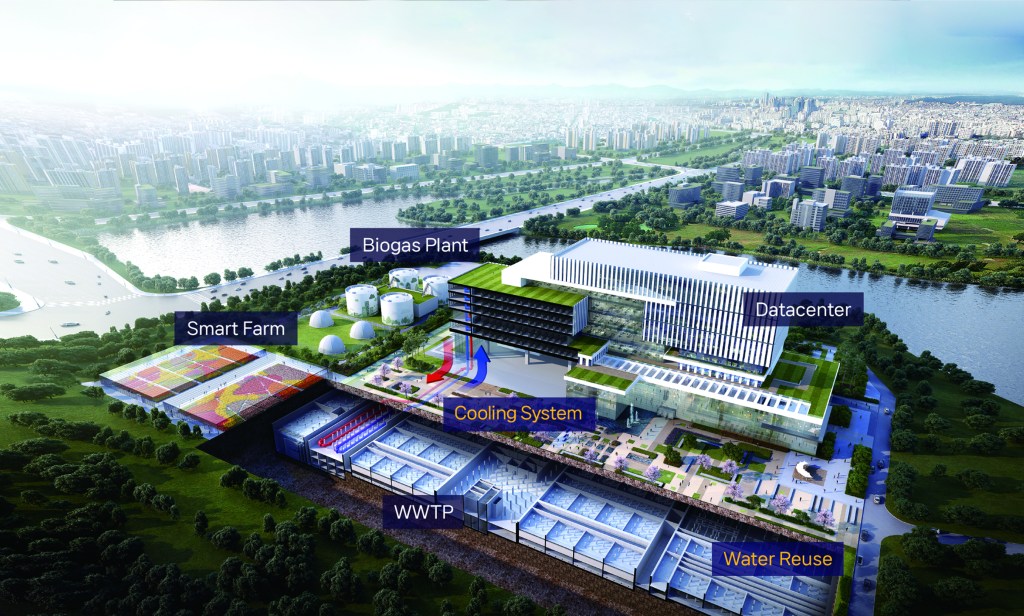
The Co-Flow Campus, a practical realization of this vision, combines biogas plants, smart farms, and data centers within a single site. Organic matter in wastewater is converted into energy, nitrogen and phosphorus into fertilizer, and treated water into cooling water—creating a fully circular wastewater ecosystem.
Expanding Innovation through Collaboration and Green Data Centers
BKT is also developing a next-generation wastewater treatment model in collaboration with KAD, a company specializing in urban infectious disease management. This model integrates wastewater-based epidemiological monitoring with an energy-self-sufficient system.
Particularly, the Green Data Center concept—using reclaimed wastewater as a cooling source and biogas as a power supply—has gained attention as an innovative solution that simultaneously addresses the location, energy, and water challenges of data centers.
As a result, BKT has established an integrated circular infrastructure system that achieves energy savings, carbon reduction, and resource recovery across the wastewater treatment process, further strengthening its technological competitiveness.
Leading Global K-ODA through Sustainable Innovation
Unlike many domestic companies focused on China and Southeast Asia, BKT established its U.S. subsidiary Tomorrow Water in 2008, validating its technologies in highly regulated markets and growing into a trusted global brand.
BKT has also expanded beyond public projects into the private sector, earning international recognition for its professional engineering teams and reliable project execution.
Recognizing these achievements, BKT was named to the Global Top Group of the Sustainable Development Goals Business Index (SDGBI) by the UN SDGs Association for six consecutive years—affirming its leadership as a sustainable innovation company.
As an OECD member country, Korea supports developing nations through the Economic Development Cooperation Fund (EDCF), emphasizing Green and Digital ODA as key strategies for climate response and digital transformation.
However, as some partner countries’ economic status has improved, OECD regulations have restricted mandatory purchases of Korean technologies and products.
This situation highlights the need for new cooperation models that prioritize practical partnerships centered on Korean innovation rather than formal aid structures.
In this evolving landscape, BKT’s Co-Flow Campus (CFC) stands out as a sustainable wastewater treatment model integrating energy self-sufficiency, infectious disease response, and digital infrastructure—offering an innovative solution that enhances the long-term sustainability of ODA projects.
The model also holds potential to evolve into a cluster-type overseas expansion platform for Korea’s water industry.
BKT CEO Dongwoo Kim stated, “We will continue to expand CFC-based K-ODA cooperation and transform wastewater treatment plants into urban resource-circulation hubs, advancing sustainable circular infrastructure models worldwide.”
* Source: Kukto Ilbo on October 27, 2025. (http://www.ikld.kr/news/articleView.html?idxno=322521)

Leave a comment